


Think about your last great game.
Not just the final score or the statistics, but how you felt. Your preparation. Your confidence. Your ability to compete freely.
What were you doing well? What helped you perform at your best?
Now think about your last difficult game.
Chances are, you can remember those mistakes in much greater detail.
The strikeout. The missed opportunity. The pitch you wish you could have back.
Why is it that we can replay our mistakes over and over, yet sometimes struggle to recognize the things we’re doing well?
That’s something we can work on.
Last week in THE CLASS, Coach Greg Moore and I encouraged our athletes to take a closer look at the small victories that often go unnoticed.
A quality at bat. A well executed pitch. A great decision. A productive response after making a mistake.
These moments matter, even when the scoreboard doesn’t reflect them.
The more we learn to recognize these moments, the better we can understand the habits, preparation, and decisions that contribute to our success.
Growth isn’t just about correcting mistakes. It’s also about recognizing what’s working, understanding why, and learning how to build on it.
Build On: The Small Victories
Baseball has a funny way of challenging how we evaluate ourselves.
You can hit four balls hard and finish the day without a hit. You can execute a great pitch and still give up a base hit. You can prepare all week, compete with confidence, and still come away disappointed with the result.
But if we only measure our development by the outcome, we risk overlooking the progress happening along the way.
During our recent class, we talked about learning to recognize the behaviors and decisions that contribute to strong performances.
Were you prepared?
Did you stay committed to your approach?
Were you able to respond productively when something didn’t go your way?
These are the things athletes can begin to recognize, evaluate, and improve.
And over time, those small victories become important building blocks for confidence.

Create Your Personal Highlight Reel
One of the exercises Coach Moore introduced was an opportunity for athletes to create their own personal highlight reel.
Not necessarily a recruiting video or something to impress people on social media.
Something for themselves.
Find three video clips and three pictures of yourself competing at your best.
Maybe it’s a double into the gap, a strikeout, a great defensive play, or a moment celebrating with your teammates.
Add your favorite song. Make it your own.
It might be 15 seconds. It might be 45 seconds.
The length isn’t nearly as important as the opportunity to recognize what you’re doing well.
Watch it before practice, in the morning, or whenever you need a reminder of what you’re capable of doing.
But here’s where I encourage athletes to go a little deeper.
Don’t just watch yourself succeed.
Study what made those moments possible.
What did your preparation look like?
Were you relaxed? Decisive? Confident?
How did you respond to the moment?
What habits and decisions contributed to that performance?
The idea is to become more aware of the behaviors that help you perform well, so you can continue developing and repeating them.
You’re not trying to convince yourself that every day will be your best day.
You’re learning to recognize what your best looks like and how to work toward it.
Confidence Is Built Through Evidence
Something I often tell athletes is to think about confidence like a piggy bank.
Every quality repetition, every productive adjustment, and every small victory is another deposit.
Some days you might make a big deposit.
Other days, it might only be a penny.
But those deposits add up.
The important thing is learning to recognize them.
A young hitter might finish a game 0 for 3, but perhaps he worked two excellent counts and drove a ball hard to the opposite field.
A pitcher might surrender a few runs, but perhaps he maintained his tempo, attacked the strike zone, and responded well after an error.
Those moments deserve attention.
Not because we’re trying to make every performance feel positive, but because we’re learning how to evaluate ourselves honestly.
Confidence grows when athletes begin recognizing the connection between their preparation, their decisions, and their performance.
That doesn’t mean confidence will always be there.
There will still be difficult games, frustrating practices, and moments of doubt.
But having a collection of positive experiences to reflect on can provide a useful reminder of what you’ve already demonstrated you’re capable of doing.
From Building On to Working On
Tomorrow, we’re taking our conversation one step further.
Last week, we focused on recognizing the small victories and learning to build on what we’re doing well.
Now, we’re turning our attention to WORK ON: Strategic Development.
How do we identify the areas that need improvement?
How do we turn setbacks into useful feedback?
And, most importantly, how do we create a plan that moves us forward?
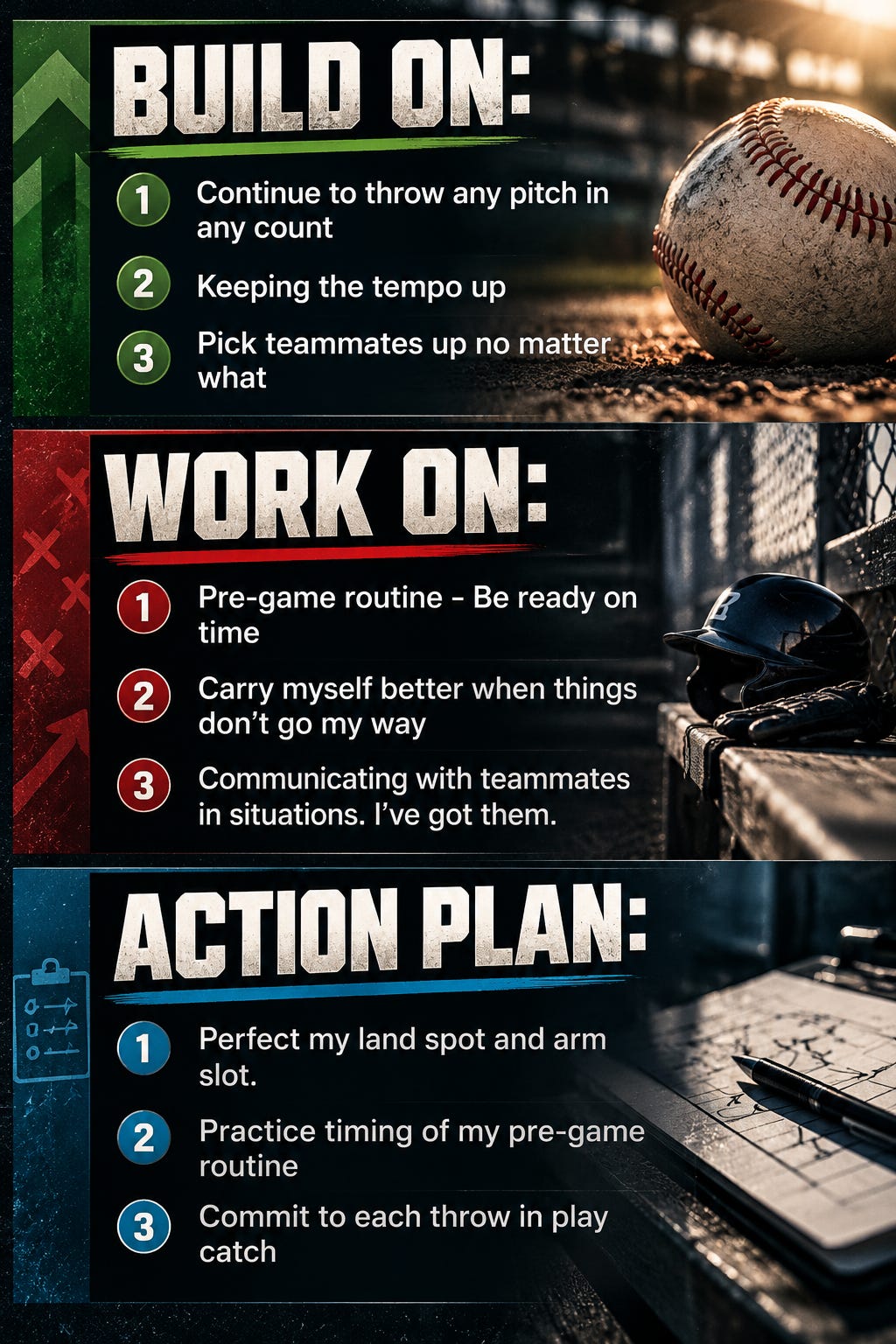
Coach Moore has introduced a reflection framework that helps athletes organize their thinking and take ownership of their development.
3 BUILD ONS
What did I do well today?
3 WORK ONS
What did I struggle with today?
3 ACTION PLANS
What specific steps will I take to improve?
This process doesn’t require an elaborate journal or hours of reflection.
Just a few minutes of honest, thoughtful evaluation.
The goal isn’t to overanalyze every mistake or demand perfection.
It’s to become more intentional about your development.
A bad game doesn’t have to become a bad week. A good game doesn’t mean there’s nothing left to learn.
Both provide opportunities to gather feedback, make adjustments, and continue improving.
The difference is what you choose to do with that information.
Your Challenge Before Our Next Class
Take a few minutes to create your personal highlight reel.
Then grab a notebook and reflect on your last game or practice.
Write down three things you did well, three things you want to improve, and three specific actions you can take.
Bring those thoughts to our next conversation.
And parents, here’s something you can try on the ride home from your athlete’s next game.
Before diving into the strikeouts, errors, or missed opportunities, ask:
“What’s something you did today that you’d like to do again?”
Give your athlete an opportunity to recognize something they did well.
Sometimes the most valuable conversation isn’t about what went wrong.
It’s about helping a young person notice the progress they may not yet recognize in themselves.
Because we’re not just trying to develop better baseball players.
We’re helping young people learn how to reflect, take ownership of their development, and move forward with confidence.
Build on what you’re doing well. Work on what needs improvement. Have a plan for both.
And don’t forget to enjoy the game along the way.
Coach Hammer
Watch Last Week’s Class
BUILD ON: The Small Victories
In our latest session, Coach Greg Moore and I explored positive reflection, building confidence through small victories, and how athletes can learn to create productive emotions through their own preparation and actions.
Watch the full episode here:
Join Us Tomorrow for THE CLASS
WORK ON: Strategic Development
Wednesday, October 21, 2026
6:00 PM Pacific | 9:00 PM Eastern
We’ll continue exploring how athletes can turn reflection into meaningful action, identify opportunities for improvement, and become more intentional about their development.
Athletes, parents, and coaches are welcome.
Free to attend.
Join live on Zoom:
https://us06web.zoom.us/j/85644389445
THE CLASS | Where Performance Skills Meet Life Skills.