


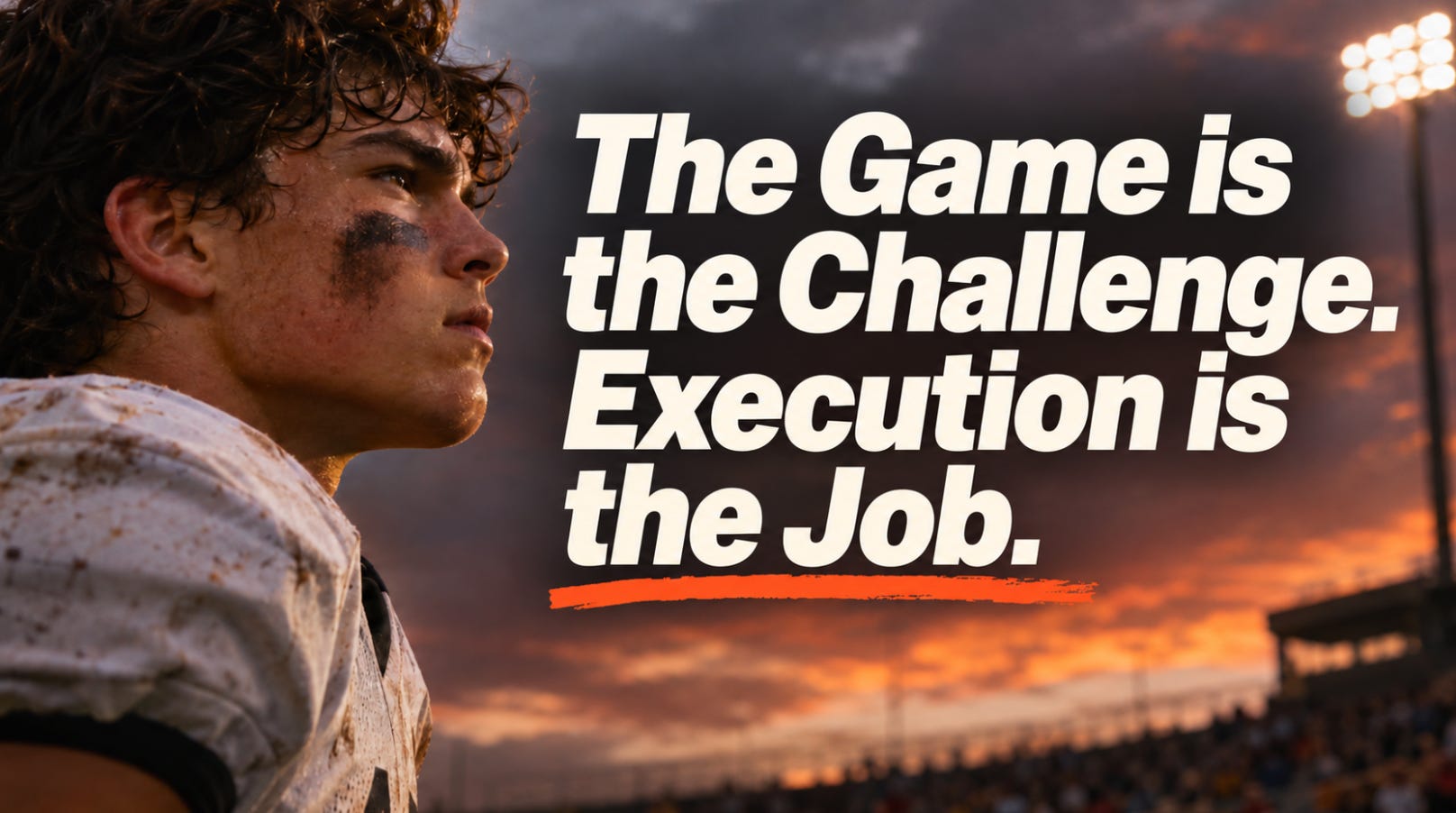
Players, be careful what you value when you compete.
Listen to NFL players, college athletes, and even high school athletes talk about upcoming games. You’ll hear phrases like, “I’m going to show out,” or “It’s time to play big on a big stage.”
High school athletes think the same way, especially when they know college coaches or recruiters might be watching.
This is a dangerous road to go down.
Why? Because the attention shifts away from the task that matters most.
For a pitcher, the job is pitch execution. For a hitter, it’s putting together quality at-bats. For a quarterback, it’s executing the offense and helping his team win.
The great quarterbacks understand this. They don’t care if they throw for 115 yards if their team wins. The goal isn’t to create a highlight reel. It’s to help their team win the game.
Just this past Sunday, Bijan Robinson rushed for only 63 yards on 20 carries, averaging 3.2 yards per carry. Not exactly a highlight-reel performance by his standards.
But his Atlanta Falcons beat the previously undefeated San Francisco 49ers, 29–20.
Leading up to that game, Robinson said something that speaks directly to this week’s Thrive Notes:
“We’re really just focused on ourselves and what we need to do.”
That’s it. That’s the mindset.
The opponent was undefeated. The stage was big. The attention was there. But the focus was on doing the job.
The Conversations We Have With Athletes Matter
This all starts with the conversations we have with athletes and, more importantly, the conversations they have with themselves.
Imagine arriving at a big national baseball tournament. Nationally ranked teams are there. College coaches might be watching. Everyone is talking about the importance of the weekend.
What’s the job?
Arrive prepared. Prepare your team to win.
Once the game starts, the job becomes even simpler.
Elevate your teammates. Execute your assignment. Hustle on and off the field. Show great body language. Compete with purpose. Help your team win.
These are the conversations athletes need to have with themselves every day, whether they’re competing in practice or playing in front of thousands of people.
The environment might change. The job doesn’t.
Parents and Coaches: Don’t Fan the Flame
Sometimes parents and even coaches unintentionally contribute to the “show out” mentality.
Three days before a tournament, the conversation becomes:
“This is a huge tournament.”
“There are going to be a lot of recruiting eyes watching.”
“These are the best teams in the country.”
“You need to play big this weekend.”
How does any of that help an athlete prepare?
It doesn’t.
The steady approach is the right approach.
It’s a game. The game is the challenge. Prepare for the challenge.
If we’re telling athletes that this tournament is bigger than the last one, we’re encouraging them to assign more value to the attention surrounding the game than to the execution required to play it well.
And that’s a mistake.
Our job as parents and coaches is to help athletes understand what matters and prepare them to do it.
You Can’t Be a Politician and a Warrior at the Same Time
Think about this.
A politician’s job is to attract votes. Gain attention. Build support. Turn that attention into elections won and legislation passed.
A warrior’s job is his job.
He’s not concerned with who is watching. His mission is in front of him.
Athletes need to think more like warriors and less like politicians.
The job is stealing this base. Catching this pass. Running this route. Executing the offense on the basketball court. Throwing this pitch away and down.
Not impressing the people in the stands.
Not creating a moment that someone might post on social media.
Not showing out.
The Job Right Now
That simple way of thinking changes how an athlete approaches practice, how they prepare for competition, and where their attention goes once the game begins.
And attention matters.
Because what we choose to value determines where we place our attention. Where we place our attention influences how we perform.
This Week: Self-Authoring
This Wednesday, we enter the final class of our ten-week program, and we’ll focus on something that connects directly to this conversation: Self-Authoring.
Self-authoring is the process of intentionally writing and developing the thoughts, goals, and beliefs that guide our actions.
Consider the questions we want athletes to answer:
What is practice?
The opportunity to prepare for execution. To build skills, develop habits, and learn how to do our jobs better.
What is the game?
The game is execution. It’s the opportunity to apply what we’ve prepared for.
What is competition?
A challenge that requires us to do our jobs well, elevate our teammates, and pursue a common goal.
These are productive thoughts. They direct attention toward things athletes can control.
And there’s some fascinating research behind self-authoring and structured goal-setting.
Studies involving college students have found improvements in academic performance and retention when students engage in intentional writing and goal-setting exercises. Some of the strongest findings involve students who were struggling academically or were at greater risk of leaving school.
Think about the significance.
Young people who took time to define their goals, examine their future, and write about how they intended to get there were better equipped to stay on track.
They didn’t simply set goals. They developed a clearer understanding of what they were working toward and why.
That’s a lesson that applies just as powerfully to sports as it does to academics.
Join Us Tonight Night
Coach Hammer and I will lead what I believe will be one of the most interesting and productive exercises of our ten-week program.
We’ll walk through self-authoring and show athletes how to begin intentionally shaping the daily thoughts that guide their preparation, performance, and lives.
Wednesday, October 28, at 6 p.m. Pacific Time.
Zoom: https://us06web.zoom.us/j/85644389445
Players, continue to self-author productive thoughts, on and off the field.
Know what you value. Know what matters.
And when it’s time to compete, do your job.
On the Adventure,
Greg Moore and Josh Hammer
ThriveWare's Mission